Alexis Carrel: The Surgical Pioneer Who Stitched the Future of Transplantation
A Legacy in Every Stitch
In the annals of medical history, few breakthroughs have been as quietly revolutionary as the ability to repair a human blood vessel. Today, complex organ transplants, coronary bypass surgeries, and life-saving vascular repairs are routine in hospitals worldwide. The foundation for these miracles was laid over a century ago by a French surgeon and biologist whose name should be far more familiar: Alexis Carrel. In 1912, Carrel was awarded the Nobel Prize in Physiology or Medicine for his pioneering work in vascular suture techniques and the transplantation of blood vessels and organs. His meticulous, almost artistic approach to stitching the delicate tubes of life—our arteries and veins—transformed surgical possibility and directly paved the way for the modern era of transplantation.
The Problem: The “Unsewable” Vessel
To understand Carrel’s achievement, one must appreciate the state of surgery in the late 19th and early 20th centuries. Surgeons could operate on organs, but a fundamental, lethal limitation existed: they could not reliably repair a severed or damaged blood vessel. Attempts to stitch arteries often led to blood clots, severe narrowing (stenosis), or catastrophic leakage, resulting in gangrene, hemorrhage, or death. Major blood vessels were considered “unsewable.” This meant that complex surgeries were often impossible, organ transplantation was a fantasy, and traumatic injuries involving major arteries were frequently fatal.
Carrel, born in Lyon, France in 1873, was deeply influenced by the tragic assassination of French President Sadi Carnot in 1894. Carnot died from a severed portal vein that surgeons could not repair. This event is said to have galvanized Carrel’s determination to solve the vascular suture problem.
The Carrel Technique: Precision as a Principle
Rejecting the crude methods of his time, Carrel brought an unprecedented level of precision and asepsis (sterility) to the operating theater. His approach was interdisciplinary, drawing on skills far beyond traditional surgery:
- The Triangulation Method: This was his masterstroke. Instead of trying to stitch a circular vessel in a continuous, pulling spiral—which inevitably caused narrowing—Carrel used three stay-sutures placed equidistantly around the vessel’s circumference. By lifting these three threads, he could transform a slippery, collapsing tube into a stable, triangular opening. This allowed for precise, leak-proof stitches to be placed between the stay-sutures without constricting the vessel lumen.
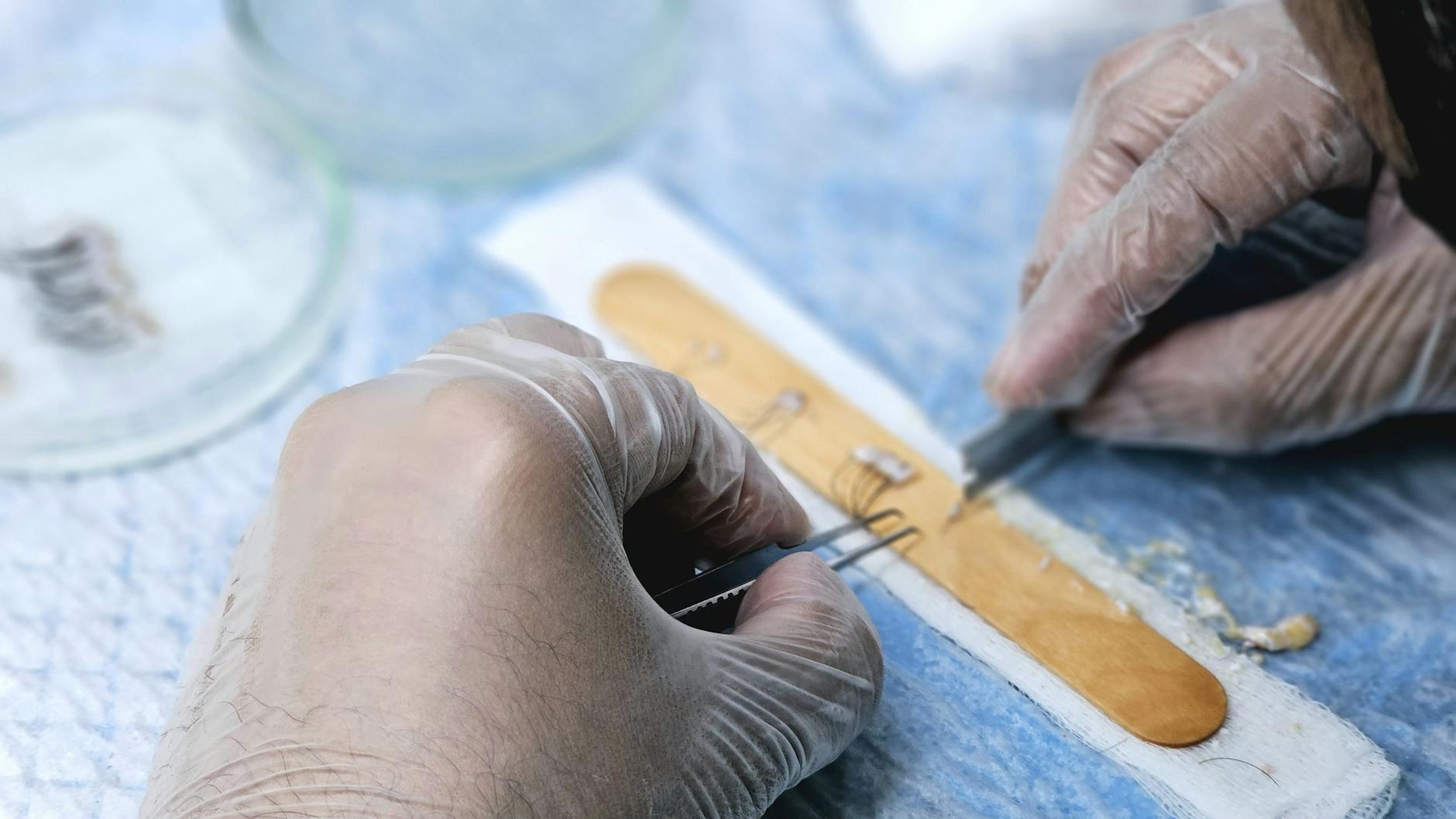
- Microsurgical Finesse, Before Microscopes: Carrel used extremely fine needles and silk thread, which he coated with Vaseline to minimize clotting. His manual dexterity was legendary; he practiced tirelessly on paper and then on the vessels of small animals, often using magnifying glasses to achieve his meticulous stitches.
- Aseptic Ritual: He insisted on scrupulous cleanliness, wearing black gowns to highlight any stray lint, and pioneered the “no-touch” technique using sterile instruments to handle tissues, drastically reducing infection rates.
- The End-to-End Anastomosis: His perfected method for connecting two vessel ends (anastomosis) ensured smooth blood flow with minimal turbulence, a critical factor in preventing clot formation.
From Vessels to Organs: The Transplantation Dream
Carrel did not stop at repairing vessels. He rightly understood that the secret to successful organ transplantation lay in mastering its plumbing—the vascular connections. If you could seamlessly connect an organ’s arteries and veins to a recipient’s blood supply, you could keep it alive.
Working primarily at the Rockefeller Institute for Medical Research in New York with physiologist Charles Guthrie, Carrel embarked on a series of daring experiments:
- He successfully transplanted veins and arteries.
- He performed autografts (moving an organ from one place to another in the same animal) and allografts (transplanting between different animals), including kidneys, thyroids, and limbs.
- In 1908, he even kept a dog’s heart alive in a glass chamber by connecting it to a circulation system, a primitive foreshadowing of heart-lung machines.
While his organ transplants between animals were ultimately rejected due to the then-unknown immune response, they were technically successful. He had solved the surgical puzzle. The vessels held, and the organs functioned—for a time. Carrel had built the house; the discovery of immunosuppression decades later would provide the key to the door.
The Nobel Prize and Lasting Impact
The Nobel Committee recognized the profound implications of his work. In awarding him the 1912 prize, they cited “his work on vascular suture and the transplantation of blood vessels and organs.” Carrel demonstrated that with exquisite technique, the human body’s circulatory system could be manipulated and repaired.
His direct and indirect contributions are woven into the fabric of modern medicine:
- Vascular Surgery: Every aneurysm repair, bypass graft, and trauma vessel reconstruction uses principles derived from Carrel’s techniques.
- Organ Transplantation: He proved the surgical feasibility of transplantation. The first successful human kidney transplant in 1954 by Joseph Murray relied on the vascular anastomosis methods Carrel pioneered.
- Cardiac Surgery: The development of coronary artery bypass grafting (CABG) is entirely dependent on the ability to suture small vessels.
- Surgical Training: He championed the ethos of meticulous practice, precision, and sterility, raising the standard for all surgical specialties.
A Complex Legacy
Carrel’s later life was marred by controversy. His interest in eugenics and his association with the Vichy regime in France during World War II tarnished his personal reputation. However, historians of science rightly separate the moral failings of the man from the objective, lasting value of his scientific contributions. The surgical techniques he developed remain ethically neutral tools that have saved millions of lives.
The Architect of Connection
Alexis Carrel was more than a surgeon; he was an architect of biological connection. At a time when blood vessels were seen as fragile, untouchable conduits, he demonstrated they could be mended, reshaped, and reconnected with the reliability of a master craftsman. By conquering the challenge of vascular repair, he unlocked a new dimension of surgery—one where blood flow could be controlled, redirected, and restored.
His Nobel-winning work provided the essential technical foundation without which modern transplantology simply could not exist. Every time a surgeon today connects a donor kidney to a recipient’s iliac vessels or sutures a delicate coronary artery during a bypass, they are performing a ritual first perfected by Alexis Carrel. He stitched together not just blood vessels, but the very future of medicine, proving that with enough skill and vision, even the most vital threads of life can be repaired.